A Market Square or a Neighborhood Green?
A market square or neighborhood green serves different daily needs. Compare surfaces, edges, access, and routines to see which layout suits a local site.
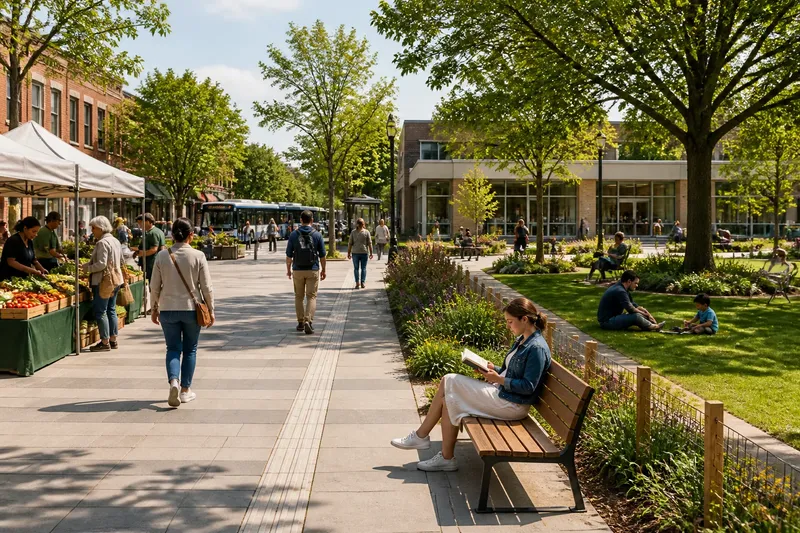
A market square or neighborhood green works best when its layout fits the ways people nearby need to move, meet, and spend time. A square usually offers an open, firm center for crossing and gathering; a green usually offers planted ground and shade for lingering. The difference is not simply paving versus grass, but how the space connects with its streets and daily routines.
Neither form is automatically better. For a proposed public space, begin with the activities it should support, then consider how its surfaces, edges, and routes can serve them.
The central surface sets the pace
A square’s continuous hard surface gives people a clear route through its center. It can accommodate foot traffic, temporary stalls, a performance, or an informal gathering without forcing everyone into a narrow path. The open middle lets people see across the space and choose where to go.
A green’s central ground is usually softer and less defined. Grass, planted areas, and shade invite sitting, playing, reading, or taking a break from the street. Paths may guide movement around a lawn, leaving the middle available for uses that do not require a fixed layout.
Surface choices affect access as well as mood. A firm, even route can work better for a wheelchair, stroller, or delivery cart than wet grass or uneven ground. A green can retain much of its planted character while using connected, firm paths to link entrances and useful destinations.
Edges connect the space to its neighbors
A market square often has a distinct boundary: building fronts, shop windows, curb lines, or trees mark where the public space begins. Active doors around its perimeter can link the square to everyday street life, even when no event is scheduled.
A neighborhood green more often has a gradual edge. A planting bed, low fence, path, or open lawn can soften the transition from sidewalk to shared landscape. But if entrances are unclear, visitors may be unsure where to enter or which paths are public.
Seating at the edges gives people choices. A bench near a busy sidewalk can suit someone who wants a short rest, while a seat beside planting may offer a quieter pause. A welcoming edge avoids making every visitor choose between the exposed center and leaving.
Daily routines show what each layout supports
A square can suit several routines that share visible ground. Someone may cross it on the way to a bus stop while another person waits beside a fountain. On market day, stalls can occupy part of the center; on an ordinary day, the same open surface can remain a route and meeting point.
A green often supports repeated, informal visits. A caregiver may walk a loop while a child uses the lawn, or a neighbor may sit beneath a tree during a break. These activities can overlap without requiring everyone to gather around one focal point.
Say a neighborhood library has a vacant lot beside it, and residents want to make the site public. In this invented situation, the stated needs are a weekly produce market, a clear walking route between the bus stop and library, and room for visitors to sit. First, mark the direct route and keep it clear; next, place a compact paved court beside it, with stalls using the court and benches at its edge; then add planting and shade where they do not obstruct the route. The expected result is a site where market activity has a defined area, while people can still pass through and find a place to rest. If residents instead prioritize casual play and quiet shade over stalls, the tradeoff points toward a larger planted area with connected paths and a smaller gathering court.
Visibility and shelter shape how a place feels
Open sightlines can make a square easy to read. Visitors can see entrances, other people, and activity in the center, which helps the space feel legible. Yet a fully exposed square may offer little comfort in strong sun or wind, and a broad surface can feel uninviting if its edges provide nowhere to pause.
Trees and shrubs can make a green feel sheltered, but dense planting near entrances may obscure paths. The useful distinction is not between planting and openness; it is between landscape that offers welcome shelter and landscape that hides routes people need to see. Low planting beside paths and tree canopy over seating can help balance those needs.
Lighting, maintained paths, and visible connections to nearby streets matter in either layout. A space that looks inviting from the sidewalk may feel less comfortable after dusk if its route is confusing or poorly lit. Local conditions, intended hours, and the people who use nearby streets should guide these decisions.
Flexibility depends on practical details
An open square can host changing activities, but flexibility needs practical support. Power access, vendor loading space, shade for people waiting, and nearby seating may matter more than a feature in the middle. If an event blocks the only walking route, its busiest use may displace everyday passage.
A green can also change with the seasons and daily routines. A lawn may serve casual play while a path remains open to people passing through; a grove can offer a distinct place to sit without dividing the whole site into rigid zones. Durable benches, waste bins, and clear paths help keep the space usable without overprogramming it.
Before choosing features, consider who will maintain them. A water feature or elaborate planting scheme may require ongoing care; a simpler arrangement of shade, seating, and connected paths may be easier to look after. Materials and operating arrangements should fit the site and the people responsible for it.
How do common needs affect the choice?
Can a market square include trees and planting?
Yes. Trees can shade seating and soften the perimeter while leaving room for crossing and occasional gatherings. Their placement should preserve the routes and usable center that give a square its character.
Can a neighborhood green have paved paths?
Yes. Firm paths can connect entrances, benches, and nearby destinations while leaving much of the site planted. That network can also help people who avoid soft or uneven ground.
Which layout suits a regular market?
A square often suits a market because its open, firm surface can support stalls and movement between them. A green may still host a small market, provided the arrangement protects planted areas and keeps everyday paths clear.
What if residents want both gathering space and greenery?
The site can combine a defined paved area with planted edges, shade, and seating, or place a small court beside a larger green. The best arrangement depends on which activities need the most room and how people will reach them.
Ordinary moments reveal whether the layout works
Look beyond a space’s signature feature. Notice where people enter, which routes they take, whether they stop at the edges or cross the center, and what happens when no organized activity is underway. A square whose center stays empty may still serve as a useful passage; a green with a busy perimeter may be providing the shade and rest visitors need.
Those observations can help residents describe a proposal in concrete terms. Instead of asking only for a square or a green, they can name a shaded seat near the library, a direct route from the bus stop, room for occasional stalls, or a lawn that remains open for casual use.
A market square or neighborhood green makes sense when its edges, surfaces, and paths work together for the people nearby. Visit the site during an ordinary weekday and again when it is busy, and note whether the same routes remain clear; that comparison can reveal which feature needs to change before the layout is settled.